 blog
blog
Destination Wedding Attire for Guests: What to Wear
Table of Contents
- What Is the Beach Wedding Guest Dress Code?
- Breathable Fabrics for Warm Weather Weddings
- Men's Destination Wedding Attire: Suits vs. Separates
- Wedding Guest Shoes for Sand and Outdoor Terrain
- Color Palettes and Accessories for Destination Wedding Attire
- How to Pack Destination Wedding Attire for Guests
- Sustainable, Inclusive, and Budget-Smart Choices
- Frequently Asked Questions
Last Updated: September 13, 2026
What Is the Beach Wedding Guest Dress Code?
A beach wedding guest dress code is shaped by sand, sun, and sea air rather than ballroom formality: breathable fabrics, relaxed silhouettes, and footwear that survives soft ground.
If you've received an invitation with "beach formal" or "tropical cocktail" and no explanation, you're not alone. This guide from Beach Bride & Groom breaks down what to wear, from fabric to packing.
The biggest mistake is treating a beach wedding like a city wedding with a nicer backdrop. Wind, humidity, and uneven sand rewrite the rules, a structured gown or heavy wool suit will wilt within twenty minutes on an open shoreline (the WHO).
The dress code is usually more forgiving than it sounds: "beach formal" means elevated but easy, while "casual beach" welcomes a flowy midi dress or linen button-down with chinos.
The table below maps the common dress code labels to what they actually mean in practice.
| Dress Code Label | What It Means | Fabric Direction | Footwear |
|---|---|---|---|
| Beach formal | Elevated but relaxed | Chiffon, silk blends, light wool | Block heels, dressy sandals |
| Semi-formal | Polished, not gown-level | Lace, crepe, tailored linen | Wedges, loafers |
| Cocktail attire | Festive and refined | Chiffon, seersucker, silk | Heels with wide bases |
| Casual beach | Comfort-first | Cotton, linen, jersey | Sandals, flats, barefoot |
When in doubt, ask the couple or their planner directly, a quick question beats showing up overdressed or underdressed.
Breathable Fabrics for Warm Weather Weddings
Breathable fabrics for warm weather weddings let air circulate and moisture escape, keeping you cool through a long ceremony and reception. The best coastal options are linen, cotton, chiffon, and seersucker.
Fabric weight matters as much as fiber type: a heavy cotton twill breathes far less than a lightweight cotton voile. Hold fabric up to light while shopping, if you can see through it slightly, it will likely move air well.
Here's how the main options compare for a seaside reception:
- Linen: The gold standard for humidity. It wrinkles, and that's part of its charm. Choose a linen blend if you want fewer creases.
- Cotton: Reliable and widely available. Look for voile, lawn, or poplin rather than heavy canvas weights.
- Chiffon: Ideal for flowy maxi and midi dresses. It layers beautifully without adding heat.
- Seersucker: A textured cotton weave that sits slightly off the skin, which helps with airflow. Classic for men's summer suiting.
- Lace: Beautiful for overlay details, but check the lining. A polyester lining underneath defeats the purpose.
One practical test: wear the garment at home for an hour in the afternoon heat. If you're uncomfortable indoors, you'll be miserable on an open beach.
Men's Destination Wedding Attire: Suits vs. Separates
Men's destination wedding attire usually works better as separates than a full suit. A lightweight blazer with tailored chinos or linen slacks gives you the polish of a suit with far more flexibility in heat.
The full-suit question comes down to dress code and time of day: a formal evening terrace ceremony may call for a matched suit in a breathable fabric, while a daytime beach ceremony almost never does.
Separates win for three reasons: you can shed the blazer after sunset and still look put-together, mixed colors photograph beautifully against ocean backdrops, and you'll rewear each piece after the trip.
For a polished separates look:
- Blazer: Unstructured, unlined, or half-lined in linen or a linen-cotton blend
- Shirt: Button-down in white, pale blue, or a subtle tropical print
- Trousers: Chinos or linen slacks in sand, stone, navy, or olive
- Optional: A lightweight tie or a pocket square instead of a full tie
Wedding Guest Shoes for Sand and Outdoor Terrain
Wedding guest shoes for sand need wide, stable bases rather than thin stilettos. Block heels, wedges, and dressy flats handle soft ground without sinking; loafers and boat shoes work for men.
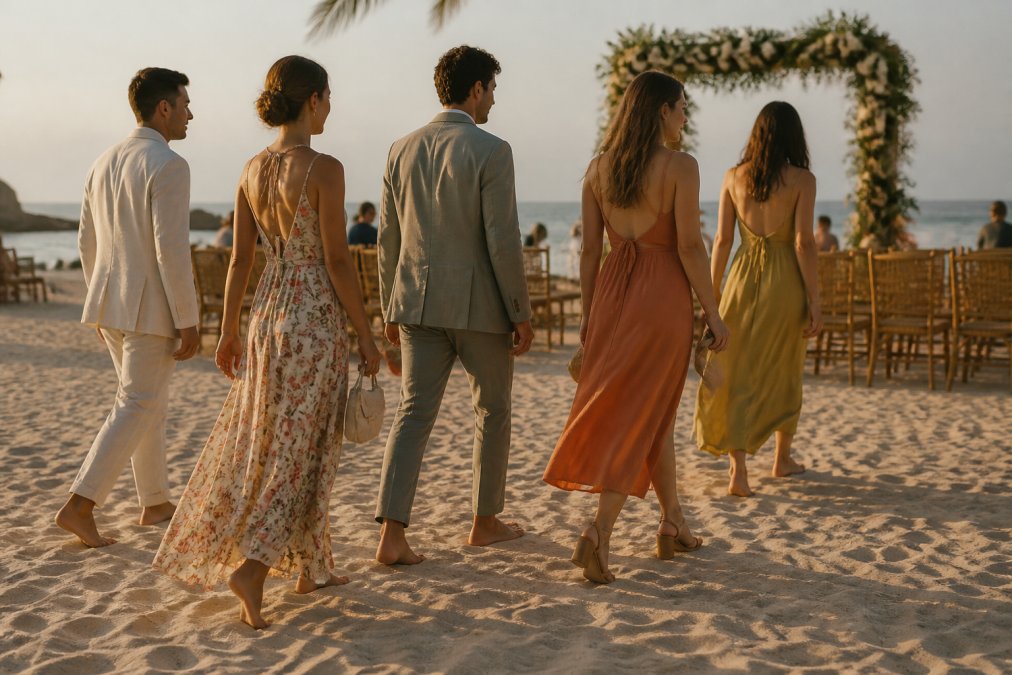
The most common mistake is buying thin-heeled sandals the week before, then balancing on your toes all ceremony. Sand swallows narrow heels.
Practical options that still look elegant:
- Block heels: The safest choice for women. Wide enough to distribute weight, dressy enough for semi-formal codes.
- Wedges: Great for stability, though they can collect sand. Choose a closed or low-profile wedge.
- Dressy flats or sandals: Perfect for casual beach ceremonies and barefoot-adjacent settings.
- Loafers or boat shoes: Reliable for men, and they pair well with chinos or linen trousers.
- Barefoot: Many beach ceremonies encourage it. Bring a pair of sandals for the reception.
If the venue involves grass, gravel, or a boardwalk before the sand, bring backup flats in your bag.
Color Palettes and Accessories for Destination Wedding Attire
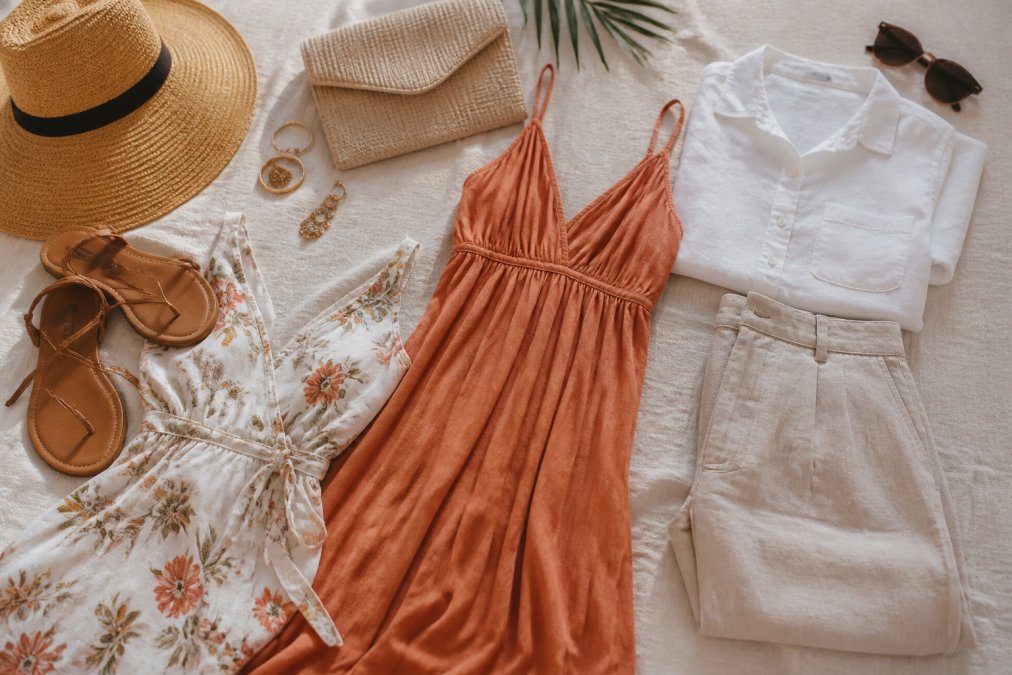
Color palettes for destination weddings lean toward soft, sun-friendly tones: coral, sand, sage, dusty blue, and warm white. They photograph well against water and sky and keep you from competing with the couple in photos.
Color choice is also about place. A destination wedding happens somewhere with its own visual and cultural vocabulary, and thoughtful guests read that vocabulary before they pack.
Read the Location Before You Read the Palette
In many destinations, certain colors carry meaning that has nothing to do with wedding aesthetics. In parts of South Asia, white and red are traditionally associated with mourning and bridal wear respectively. In some East Asian cultures, white flowers and all-white outfits are tied to funerals. In several West African and Caribbean traditions, bright, saturated colors are celebratory and expected, while muted tones can read as somber.
This doesn't mean abandoning your personal style. A five-minute search before you shop, "what to wear to a wedding in [country]" plus "guest attire customs", tells you whether your favorite sage midi is safe or a quiet faux pas.
Modesty Requirements You Should Actually Plan For
Many destination weddings take place in countries or at religious venues with specific dress expectations. Common patterns include:
- Covered shoulders and knees at temples, mosques, and some churches, even in tropical heat. A light linen wrap or a long-sleeved linen shirt solves this without adding bulk.
- Shoes off at certain religious sites. This is another argument for footwear you can slip on and off easily, and for a pedicure you're happy to show.
- Swimwear only at the pool or beach, never at a ceremony or reception, even a casual one. This sounds obvious until you're at a resort where everyone has been in a bikini all week.
- Head coverings at some venues. If the couple hasn't mentioned it, ask. A lightweight scarf in your bag costs nothing and saves a lot of awkwardness.
The rule of thumb: when local custom and personal comfort conflict, local custom wins for the ceremony itself. You can change for the after-party.
Accessories That Work With Wind, Sun, and Sand
Accessorizing for a seaside reception requires a light touch. Heavy jewelry catches wind and reflects harsh sun unflatteringly; lean into pieces that move with the breeze.
A few guidelines worth following:
- Avoid all-white or ivory unless the couple has explicitly said otherwise. That's still the couple's color.
- Skip black for daytime ceremonies. It absorbs heat and reads too formal for most beach settings.
- Choose statement earrings over heavy necklaces. They photograph beautifully and won't tangle in wind.
- Add a light wrap or pashmina for evening ceremonies. Coastal temperatures drop quickly after sunset, and a wrap doubles as modesty coverage if the reception moves indoors to a religious or conservative space.
- Bring a sun hat for daytime events, but plan to remove it during the ceremony itself.
- Skip the oversized tote for the ceremony. A small clutch or crossbody keeps your hands free for photos and drinks, and won't blow off a chair.
Tropical prints work for casual or cocktail codes, but keep the scale moderate, a bold all-over print can dominate group photos, and in some destinations a print that reads "tropical" to you may read as a specific cultural or religious motif to locals. When in doubt, choose a solid in a sun-friendly tone and let accessories carry the personality.
How to Pack Destination Wedding Attire for Guests
Packing for a destination wedding starts with the ceremony outfit, then builds outward. Roll wrinkle-prone fabrics rather than folding, and pack a travel steamer or wrinkle-release spray in your carry-on.
Packing tips that actually save you on the day:
- Roll, don't fold. Linen and chiffon crease less when rolled tightly.
- Use packing cubes to separate ceremony attire from casual wear.
- Pack the ceremony outfit in your carry-on if you're flying. Checked bags get lost.
- Bring a small stain pen. Sand, salt, and spilled drinks happen.
- Include a backup pair of shoes if the venue involves varied terrain.
- Add a light layer for the evening temperature drop.
Humidity affects how fabric drapes: a dress that hangs perfectly at home may cling differently in coastal air. Try your outfit on after you arrive, ideally the day before, so you have time to steam or press it.
Sustainable, Inclusive, and Budget-Smart Choices
Sustainable destination attire means choosing natural, durable fabrics and pieces you'll genuinely rewear rather than single-use fast fashion, better for the planet and your wallet.
A linen midi dress or well-cut linen blazer can be worn to brunches, other weddings, and dinners for years, while a cheap synthetic gown worn once often ends up in a landfill.
The Rewear Test: A Simple Filter Before You Buy
Before you buy anything for a destination wedding, run it through three questions:
- Would I wear this on a non-wedding vacation? If yes, it's a wardrobe piece, not a costume. If no, it's a one-time purchase, and you should price it accordingly.
- Does it work in at least two settings? A linen midi with a denim jacket reads casual; the same dress with statement earrings and a wrap reads semi-formal. Versatility multiplies wear count.
- Can I style it in three different color stories? If a piece only works with one pair of shoes and one bag, it's not versatile, it's a matching set waiting to be retired.
A piece that passes all three is worth paying more for. A piece that fails all three is worth renting, borrowing, or skipping.
Rental, Resale, and Borrowing: The Practical Playbook
For a one-time destination event, renting is often the smartest financial and environmental move. Rental platforms for formal and semi-formal attire have expanded and many ship internationally with adjustable sizing. The trade-offs are real, limited stock in your size during your travel window, and you're responsible for damage, but for a dress or suit you'll wear once, the math usually favors renting.
Resale is the other underused option. Poshmark, Depop, and The RealReal carry gently worn formalwear at a fraction of retail, with a fraction of the environmental footprint. For men especially, a secondhand linen blazer in a classic color is often indistinguishable from new and costs half as much.
Borrowing is the oldest option and still the best. A friend's wrap, a sister's clutch, a cousin's block heels, accessories are where borrowing shines, because they're the least size-dependent part of the outfit.
Inclusive Fit: What to Look For Beyond the Size Chart
Destination attire should work for every body type, which means prioritizing adjustable elements over precise tailoring:
- Wrap styles and tie waists adjust to your shape rather than the other way around.
- Elasticated or smocked backs add give without looking casual.
- A-line and flowy silhouettes drape rather than cling, which matters in humidity.
- Adjustable straps and convertible necklines let you change coverage as the day shifts from ceremony to reception.
- Stretch-lined waistbands on trousers and skirts are a quiet game-changer for long ceremonies on uneven ground.
For plus-size guests, the biggest practical issue in tropical heat isn't style, it's chafing and support. Look for breathable natural fibers with stretch, consider anti-chafing shorts under dresses, and prioritize moisture-wicking bras over molded foam, which traps heat. Plus-size formalwear brands have grown in number and many now match straight-size fabric quality rather than the polyester-heavy options that once dominated.
For men, inclusive fit often means the difference between a tailored look and a boxy one. A linen blazer that fits at the shoulders can be taken in at the waist by any tailor for a modest fee, almost always less than buying a second, better-fitting jacket.
Coordinating a Group Without Matching Outfits
For a cohesive group look, bridesmaids, groomsmen, or family, focus on a shared color palette and fabric direction rather than identical garments. It reads intentional without feeling matchy and lets each person choose a silhouette that fits their body and comfort needs.
A practical approach: pick two or three colors from the couple's palette, agree on a fabric family (linen, chiffon, or cotton), and let each person choose their own cut. The result photographs as a unified group and wears far better than a one-shape-fits-all approach.
Guests who need to coordinate outfits for a large, mixed-body-type wedding party and want breathable, rewearable pieces rather than one-time purchases.
Frequently Asked Questions
What does a beach formal dress code mean for destination wedding attire?
Beach formal sits between cocktail and black-tie. For women, that means a floor-length or midi dress in a breathable fabric like chiffon or linen, paired with dressy sandals or block heels. Men should wear a lightweight suit in linen or seersucker, or tailored chinos with a blazer. Skip heavy satin, dark tuxedos, and leather dress shoes that trap heat. The goal is polished but relaxed, so you feel comfortable standing on sand during the ceremony.
What fabrics work best for breathable warm weather wedding attire?
Linen, chiffon, cotton, and seersucker let air circulate and dry quickly, which matters when humidity is high. Linen wrinkles, but that relaxed texture suits a coastal setting. Chiffon drapes beautifully and stays light. Avoid polyester blends and heavy satin, which trap heat and show sweat. For men, an unlined linen blazer over a cotton button-down breathes far better than a lined wool suit. Light colors also reflect sun rather than absorbing it.
What shoes should guests wear to a wedding on sand?
Block heels, wedges, and dressy flat sandals work best because they distribute weight and won't sink the way stilettos do. Men can wear loafers, boat shoes, or leather sandals, and many choose to go barefoot once the ceremony starts. Bring a backup pair of flats if you plan to dance. Avoid thin heels, heavy boots, and new shoes you haven't broken in. A small tip: test your shoes on loose sand before the trip.
What colors should guests avoid at a destination wedding?
Skip white, ivory, and cream, which are reserved for the couple. Also avoid the exact bridal party color if the couple has announced one, since you don't want to look like an accidental member of the wedding party. For beach settings, opt for coral, sage, terracotta, dusty blue, or soft yellow. These tones photograph well against sand and ocean backdrops. If the invitation specifies a palette, follow it. Otherwise, choose shades that feel festive without competing with the bride.